
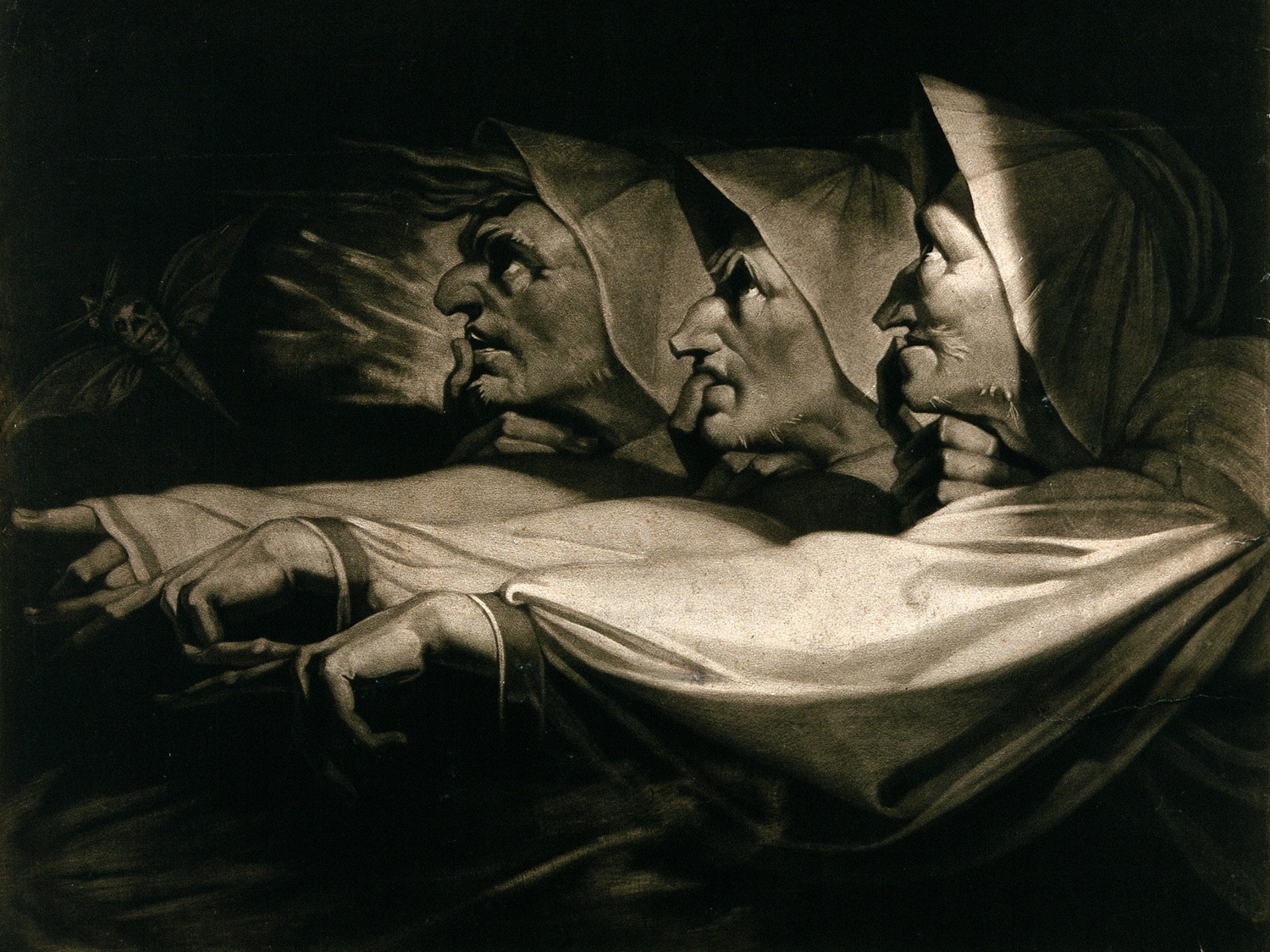
The Three Weird Sisters in Macbeth. Mezzotint by J.R. Smith, 1785, after Henry Fuseli 1783.
© Wellcome Foundation / Public domain
If there is no boundary between real and unreal, good and evil, life and death, then nothing means anything, and we face a nihilist abyss.
Revolution, Hannah Arendt writes, is “inextricably bound up with the notion that the course of history suddenly begins anew.”
The act of revolution overcomes a boundary, setting in motion what had previously seemed impossible. This was the experience of the Maidan, the Ukrainian revolution of 2013–2014. This is also the European heritage. In her introduction to the Italian translation of my book The Ukrainian Night: An Intimate History of Revolution, the political philosopher Olivia Guaraldo dwells upon the reasons for “the West’s blindness to the spontaneous rise of a democratic movement opposing authoritarianism.” Why, she asks, did so many Europeans look the other way?
Western European condescension toward Eastern Europe is not a rarity. The issue, though, is not simple condescension. “It is almost as if,” Guaraldo writes, “the West were jealous of a revolutionary paternity that it is unwilling to concede to others.” The subliminal possessiveness toward a revolutionary heritage adds another dimension to Ukrainian art curator Vasyl Cherepanyn’s observation that the Maidan “was so fundamentally European that it turned out to be too European for today’s EU.”
Perhaps Europeans were jealous. Or perhaps, Guaraldo suggests, something else inhibited them from truly seeing the Maidan: perhaps they have forgotten what revolution means. She recalls Arendt’s idea of revolution as a revelation of natality, the human capacity to give birth to something new, miraculous in its improbability and “startling unexpectedness.”
Europeans have forgotten about natality.
***
By chance, I was present in Kyiv this year for another improbable and unexpected event: a massive Ukrainian drone attack reaching thousands of miles into the Russian interior. Operation Spiderweb, carried out during the early hours of June 1, struck dozens of Russian aircraft. The long-percolating stealth operation used inexpensive, domestically made drones to destroy long-range Russian bombers—precisely those bombers that had been relentlessly launching missiles into Ukraine night after night.
“This is brilliant military planning and execution. Absolutely brilliant,” Janice Stein, the director of the Munk School of Global Affairs and Public Policy, told a Canadian journalist. “What the Ukrainians have done with drones. . .no one imagined it would go at this pace.”
It was true: no one had imagined this.
***
“Ukraine right now is more European than Europe is,” said the Odesa-born American poet Ilya Kaminsky, speaking at the Kyiv Book Arsenal just hours before Operation Spider’s Web. He added: “America,” he added, “already forgot why it exists.”
Europeans have forgotten what birth means, while Americans have forgotten what death means. We Americans are, perhaps, especially susceptible to this forgetting: a denial of the tragic runs deep in American culture. And nothing is more tragic than death, the fact that, as Jan Patočka writes, “Man is always essentially in a hopeless situation. . .We are a ship that will necessarily be shipwrecked.”
Martin Heidegger names this “hopeless situation” Sein-zum-Tode. We live amid a constant temptation to flee from awareness of it. For Heidegger, to submit to this temptation, which Sigmund Freud might describe as denial, is to live in a “fallen,” “inauthentic” mode. In this mode, we lose ourselves in the flow of the crowd and the chatter of the everyday. Yet the present moment goes beyond the lure of an escape into inauthenticity. Something more radical is taking place.
During the first Trump administration, at a Stanford University conference honoring the career of the philologist Hans Ulrich Gumbrecht, there was an animated discussion about Heidegger’s idea of Sein-zum-Tode. At one point the youngest person in the room, a Stanford undergraduate, stood up. He did not relate to the questions at stake in the discussion, he explained, because he, for one, had no expectation that he was ever going to die. He lived in Silicon Valley: death was just one more problem for which experimenters were working on a technological solution.
It is unlikely that Heidegger could have imagined this deathless Silicon Valley, where Mark Zuckerberg and Jeff Bezos have invested in anti-aging science, and where (relatedly and perhaps not as paradoxically as it might seem) individual human beings are increasingly considered replaceable. Zuckerberg has assured people that Meta’s new chatbots would fill in the empty spaces in their lives. (The average American has fewer than three friends, he said, while demand is on the order of 15.)
For Peter Thiel, the Silicon Valley begetter of Vice President J.D. Vance, mortality is one more limitation to be conquered. Long ago, in anticipation of resurrection, he told New York Times journalist Ross Douthat, he arranged to have his body cryonically preserved:
Thiel: I remember 1999 or 2000, when we were running PayPal. . .we had one day where we took the whole company to a freezing party. You know a Tupperware party? People sell Tupperware policies. At a freezing party, they sell. . .
Douthat: Was it just your heads? What was going to be frozen?
Thiel: You could get a full body or just a head.
Elon Musk has been focused on going to Mars and in any case believes that we are living in what is only a simulation. This is perhaps what makes it easy for the richest man in the world to forcibly take food away from starving children and deny the reality of their resulting deaths. The New York Times columnist Nicholas Kristof went to Sudan and immediately refuted that with empirical evidence: he found children dead and dying. This appeared to make no impression at all on Musk.
***
The present American moment shares much with the present Russian moment—paradoxically, because the trope of tragedy, the inescapability of fate, has long saturated Russian culture. Now, though, in a postmodern Aufhebung of the tragic, the worlds cultivated by the American and Russian presidents alike are dominated by actors who believe in neither life nor death. Donald Trump has called soldiers killed in action “losers.” Kremlin propagandists have reassured television viewers that the fallen are being resurrected. Russian conscripts are being offered reincarnation, while Vladimir Putin has promised Russians that military victory would bring immortality. In the meantime, he has ordered Russian scientists to develop ways to prevent aging. In September, he and China’s President Xi Jingping were caught on a hot mic discussing their aspirations for overcoming mortality. “As biotechnology continues to develop,” Putin said to Xi, “human organs will be continuously transplanted, and people will become younger and perhaps even achieve immortality.”
***
In Heideggerean terms, it is only the confrontation with mortality—facing our human condition of Sein-zum-Tode with eyes wide open—that shakes us into authenticity. In the absence of death, life has no weight. Death is the precondition for life to have value.
“You don’t have any cards,” Trump said to Ukraine’s President Volodymyr Zelensky during their Oval Office meeting in February.
“We’re not playing cards,” Zelensky answered.
For Trump everything is a game. All encounters are purely transactional; no human relationship has any meaning on its own. For Zelensky, conversely, life is real because death is real; and he is confronting death every day.
The Galician Germanist Jurko Prochasko, who has (perhaps not incidentally) translated Heidegger into Ukrainian, describes Trump as “The Joker of the Apocalypse.” In the United States, there is no longer a boundary between reality and artificial intelligence-generated beach casino fantasies of ethnic cleansing, or a scythe-bearing Grim Reaper stalking Democrats as Trump and Vance accompany a vocalist singing a warped Blue Öyster Cult cover with the refrain “Now their time has come.”
“Remember the witches in Macbeth?” Irina Scherbakowa, a founder of the Russian human rights organization Memorial, asked an audience in Prague in 2024. “Fair is foul, and foul is fair/Hover through the fog and filthy air,” the witches told Macbeth.
“The witches say that some kind of boundary between good and evil is being removed, some rot is being created, some smoke that shrouds history and basic values, and it is under the guise of this rot and smoke that Putin came to power,” Scherbakowa said.
There is an intimate connection between the denial of death, the reign of post-truth, and the witches’ words. All speak to a refusal to acknowledge boundaries. “The Russian world has no borders,” declared Vladislav Surkov, Putin’s original spin doctor. The implications of this statement transcend the geographical. For Trump as for Putin, there is no boundary between real and unreal, good and evil, life and death. In the absence of any boundary, nothing means anything, and we face a nihilist abyss.
Marci Shore is chair in European intellectual history at the Munk School of Global Affairs and Public Policy, University of Toronto, and a recurrent fellow at the IWM.


