
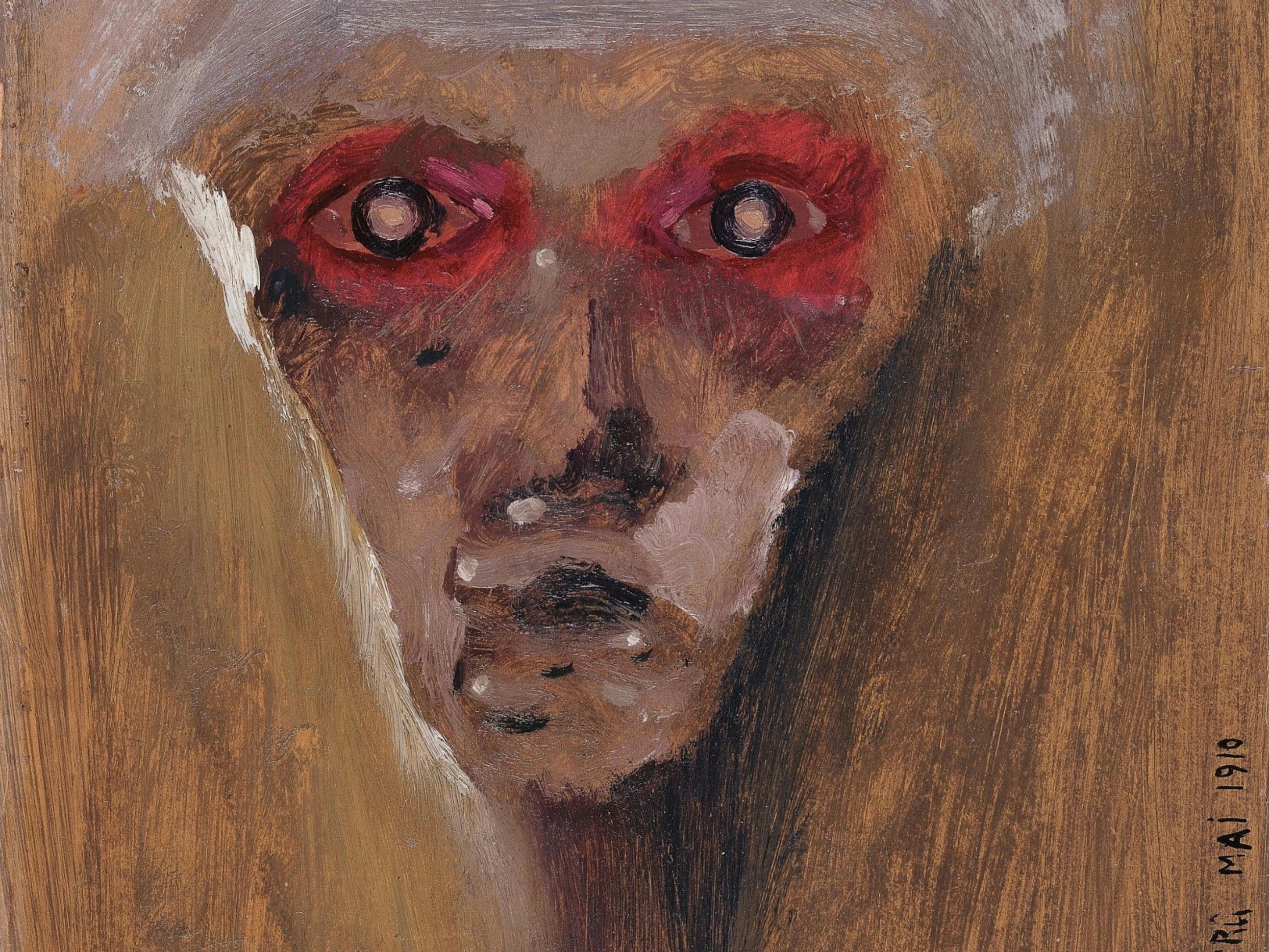
Arnold Schoenberg, Gaze (Karl Kraus – The Great Wall of China), 1910
© artsdot.com
There have been many modernities: political, philosophical, literary, sociological. But what do we know of the hidden one, the esoteric modernity that runs in the background of psychoanalysis, music, history of art, and even science? The Leopold Museum’s Verborgene Moderne exhibition, curated by Matthias Dusini and Ivan Ristić, brings us to the heart of the Viennese occult modernity.
Around 1900, Vienna emerged as a major center of the occult movement. Fascination with parapsychology, spiritism, astrology, meditation, yoga, vegetarianism, and the new dance grew under the influence of Helena Blavatsky’s theosophy and Rudolf Steiner’s anthroposophy. Three iconoclastic figures are emblematic of this moment: a prime-number theorist enthralled by knots that might unveil a new spatial dimension, a revolutionary composer striving to paint the human soul, and a renegade painter drawn to the titanic gaze and social reform.1
Spiritual Exercises
Oskar Simony (1852–1915) was a professor of mathematics and physics at Vienna’s University of Natural Resources and Life Sciences. After teaching for 37 years, he retired to work on his project regarding prime numbers. He made complex calculations without the aid of electronics, which he carried out with a near masochist discipline. In a diary entry from April 6, 1914, he recorded his progress: “At present, I have 3 books with 70 pages and 19 books with 80 pages, thus 1,739 pages per 8 number, which in total amounts to 13,840 numbers.”
The Viennese mathematician became fascinated by the “Zöllner knots”. During a series of spiritualist séances, the German astrophysicist Johann Karl Friedrich Zöllner claimed that knots had mysteriously appeared in a closed loop of string: a ring of cord whose ends were sealed, making it impossible to untie or open in order to form a knot. He interpreted this phenomenon as proof of a fourth spatial dimension. Simony sought to reproduce these knots and to analyze them mathematically. In an 1884 paper, he commented on Zöllner’s experiments, fully aware that his scientific reputation was at risk, since in the positivist climate of his time any interest in the supernatural was dismissed as medieval superstition.
During an 1888 research trip to the Canary Islands, where he carried a 40-kilo spectrometer to the top of a 3,711-meter volcano, Simony had a life-changing religious experience. In an almost pre-Wittgensteinian manner, he refers to its ineffable dimension in his diary: “There are realizations that can only be experienced but cannot be taught.” The language of silence is more appropriate for such an experience because “words are meaningless / and forgettable,” as Depeche Mode suggests. Simony’s life quest, combining his interest in mathematics and passion for esotericism, can be summarized using an argument from Peter Sloterdijk’s Du mußt dein Leben ändern [You Have To Change Your Life] (2009). The German philosopher claimed that spiritual exercises can be helpful for those affected by the pathology of nihilism: the ascetic discipline provides a structural soothing dimension to the dissociative and meaningless context of our (post)modern lives. This may be one of the therapeutical values of the occult.
Painting Sounds
Can we put colors into sound? Can we see into the unknown and record it? The metaphysical dimension of music may help us. The first works of the composer, theorist, and painter Arnold Schönberg (1874–1951) belong to the post-Romantic tradition of Wagner and Mahler. He later broke away from tonality altogether, inventing Dodekaphonie around 1923, which marked the departure with traditional harmony. Listen to Verklärte Nacht Op. 4, his string sextet from 1899, to catch a glimpse of the first Schönberg.
Schönberg wanted to paint the gaze, not merely express inner vision through music. He called his amateur sketches and pictures “painted music,” or a way of “making music with colors and shapes.” His drawings, portraits, and manuscripts are displayed at the Arnold Schönberg Center. The composer confesses he cared less about faces and more about gaze as vehicles of accessing the inner human being. If we closely look at some of Schönberg’s paintings from 1910, such as Memory of Oskar Kokoschka or Karl Kraus – Die chinesische Mauer, we see the composer transcending the dictates of empirical materialism, trying to capture the essence of someone’s personality through the pictorial recording of hidden energy.
The gaze transcends the mask-face dichotomy. While the mask conceals the face, the gaze penetrates both, opening a passage toward repressed depths. Beyond the Jungian notions of persona and ego, it unveils the subterranean self. Hence, the painter-musician moves within the realm of prelinguistic ambiguity, in that synesthetic threshold where the unconscious seeps into the canvas of sur(reality). If Schönberg’s paintings seek to grasp the “soul” through color, his chromatic music of the same period translates color into sound, most vividly in Op. 16, No. 3, Sommermorgen an einem See (1909).
Figures of Revolt
Schönberg was not the only one to regard the gaze as a key to accessing human personality. The German painter and illustrator Fidus (pseudonym of Hugo Höppener, 1868–1948) likewise created portraits of larger-than-life figures such as Giordano Bruno, Goethe, and Beethoven, all conceived around their visionary gaze. Influenced by symbolism, Art Nouveau, and the Vienna Secession, Fidus was a disciple of the painter and social reformer Wilhelm Diefenbach, who created the first programmatic painting against meat consumption, Thou Shalt Not Kill (1903). Höppener became a member of Diefenbach’s commune and even served a prison sentence for public nudity on his mentor’s behalf, which earned him the nickname Fidus (Faithful).
The (post-)Romantic fascination with subversive figures, such as Prometheus, who defy tyrants is a recurring theme in European culture, from Goethe to Shelley, and from Marx to Nietzsche. In certain versions of the myth, Prometheus (forward-thinker in Greek) not only gave fire to humanity but is also said to have made humans from clay. Goethe alludes to this in 1774 poem: “Here I sit, forming men / In my image, / A race to resemble me: / To suffer, to weep, / To enjoy, to be glad – / And never to heed you, / Like me!” According to Goethe’s antiauthoritarian interpretation of the myth, humanity has a distinctive rebellious quality, a Heraclitean urge to constantly move forward and refuse submission to rule. It is as if Prometheus is compelled to disobey Jupiter. “The Titanic artist found within himself the defiant belief that he could create human beings and destroy the Olympian gods at least,” Nietzsche wrote in his irreverent 1872 Birth of Tragedy.
Fidus’s 1898 portraits of the Promethean Lucifer evoke Helena Blavatsky’s parallel between the two archetypes of rebellion. In her 1877 Isis Unveiled, she noted that Prometheus gave the divine fire to man in order to transform “the most perfect of animals on earth into a potential god … Hence also, the curse pronounced by Zeus against Prometheus, and by Jehovah-Il-da-Baoth against his ‘rebellious son,’ Satan.” In other words, both archetypes refer to knowledge, which can be afterward used to conquer sancta sanctorum: the elusive fruit of the tree of life. Or, in Blavatsky’s more straightforward expression, now we are free to “take the kingdom of heaven by violence.”
*
Knots that unveil the fourth dimension, musical paintings of the astral body, titanic gazes that turn dictators to stone—these are just three tales from Vienna’s secret history. Countless others await discovery at the Leopold Museum, where this remarkable exhibition runs until January 18, 2026.
1 For the writing of the three portraits, I am indebted to Matthias Dusini, “‘I really have to be on my guard.’ The Mathematician Oskar Simony Between Natural Sciences and Esotericism”; Ivan Ristić, “New Bygone Times. Impressions from the Pantehon of Hidden Modernism”; and Therese Muxender, “Arnold Schönberg – The Composer’s Eye”, in Matthias Dusini, Ivan Ristić, and Hans-Peter Wippinger (eds.), Hidden Modernism. The Fascination with the Occult Around 1900, Verlag der Buchhandlung Walther und Franz König, Köln, 2025.
Ștefan Bolea is a writer and translator from Romania. He was a Paul Celan fellow at the IWM in 2025.


