
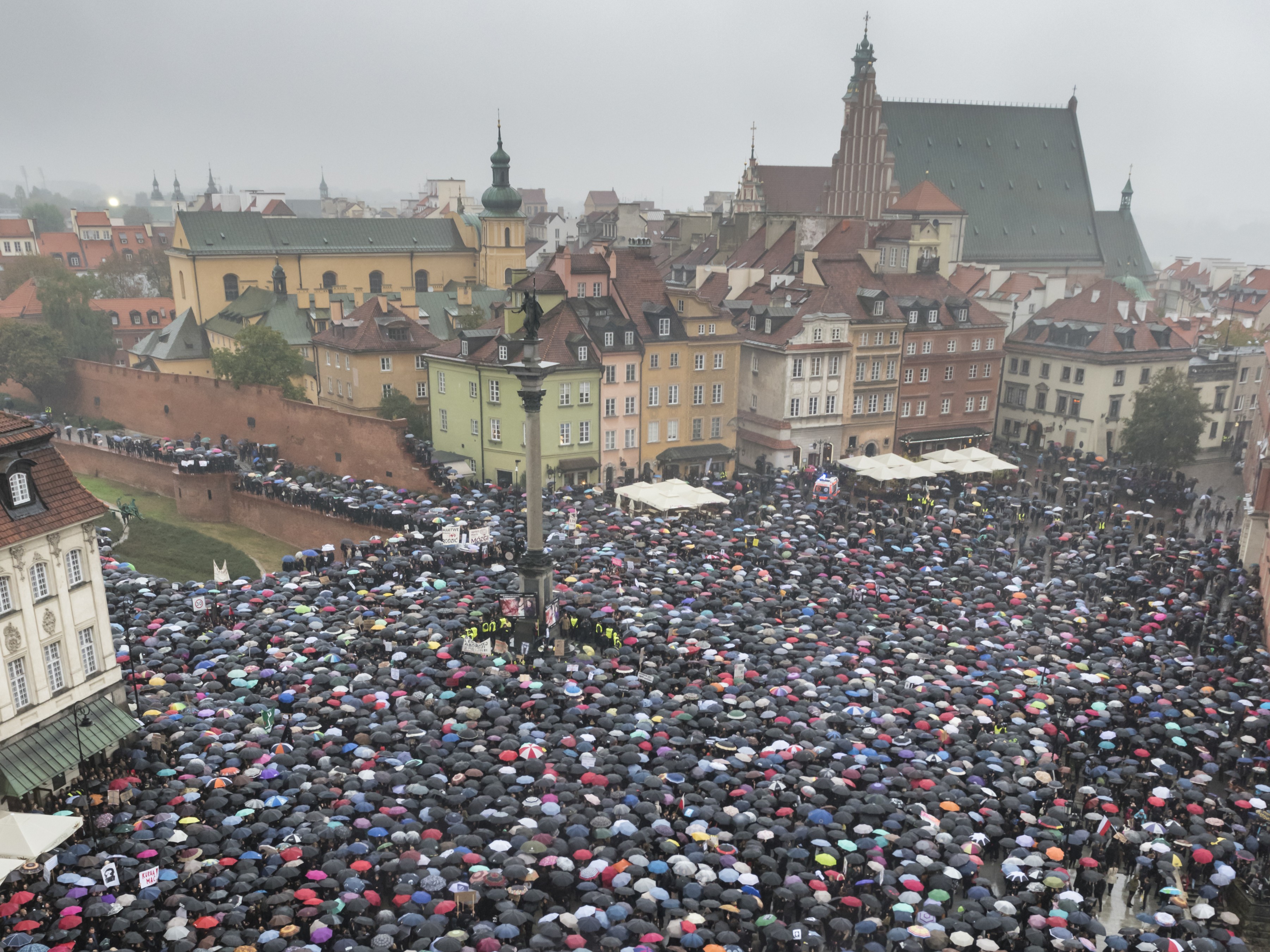
Polish women holding umbrellas protest a legislative proposal for a total ban on abortion, Warsaw, October 3, 2016.
© Cinematographer / shutterstock.com
The Polish women’s movement turned the legacy of sacrifice into a weapon for suffrage. With nationalism as its ally, it was among the world’s first to secure voting rights. Yet, the doors to power remained firmly shut to women.
Slowly but relentlessly, the noise becomes unbearable. Józef Piłsudski is busy. And tired. And the tapping really does not help.
It is November 1918. After four bloody years, the Great War has drawn to an end, leaving a broad swath of destruction across Central Europe—and a political opening. Of the powers that had divided Piłsudski’s homeland, Germany has just signed a humiliating capitulation, Austria is collapsing, and Russia is convulsed by revolution. For the first time in 123 years, Poland has a genuine chance at independence.
In Warsaw, power lay in the street. So Piłsudski picked it up. He now heads a state that lacks fixed borders, a unified authority, and international recognition. He is busy. And tired. And when a women’s delegation knocks that November evening, Piłsudski turns them away.
Nevertheless, they persist. When knocking on the door fails, they seize their umbrellas and begin tapping on the windows. Finally, Piłsudski relents. Three burst into the room and demand that the nascent Polish state grant voting rights to women. And Piłsudski agrees. The first article of the decree on electoral law he signs two weeks later says that “Every citizen of the state, regardless of sex, is eligible to vote.”
It is a fine story: concise, vivid, and with a gratifying resolution. Brave women, armed with umbrellas, compel a mustachioed warrior to grant them rights in a single, rainy evening.
Alas, it is not true. No source mentions such a confrontation. The press of the time reported only that Piłsudski met with a delegation from the Committee for the Equal Rights of Polish Women, which demanded that women be included in the emerging government. He declined regarding the ministerial posts but “responded with full kindness” and said there was “complete unanimity” among all political parties “on the issue of granting women political rights.”
The umbrella assault is an urban legend, and a fairly recent one at that. Norman Davies’s seminal history of Poland, God’s Playground, does not even mention Polish women gaining suffrage; it was not, apparently, an event worth noting. School textbooks dispatched the matter in a sentence: the electoral ordinance of November 28, 1918, granted women the right to vote.
Only in the 2000s did monographs on the Polish suffrage movement begin to appear. Sławomira Walczewska’s Damy, rycerze, feministki (Ladies, Knights, Feminists, 2006) notes that the delegation waited several hours outside Piłsudski’s villa. In the following decade, umbrella-tapping was added, and the story entered the media mainstream.
It is hardly coincidental that this happened when a conservative government tried to impose a total abortion ban. Thousands of women took to the streets, and since it was a rainy October day, they carried umbrellas. The parallel was irresistible: umbrellas had secured voting rights in 1918; in 2016, they defended reproductive freedoms.
Except no umbrellas were involved. And Piłsudski was not the sort of politician to be intimidated by activists. Nor was he an emblem of allyship; like many socialists of his time, he viewed women as a potential conservative voting bloc, making their suffrage contrary to his political interests.
This leaves us with the real question: why were Polish women among the earliest in the world to secure voting rights and why did the process, at least in the home stretch, unfold with scarcely any opposition?
In the West, suffragists demanded the vote from the state. They sought to persuade politicians and the public that women were not only capable of but entitled to full citizenship. In the 19th century, this was a radical proposition. The prevailing model of womanhood was the “angel in the house”: a fragile creature whose destiny was to bear children and tend to the male ego. Coventry Patmore, in his celebrated poem, put it bluntly: “Man must be pleased; but him to please / Is woman’s pleasure.”
Stepping beyond that “natural” order to seek education, to work for wages, even to mount a bicycle was seen as a threat to society. Political power, the last bastion of the “separate spheres”—public for men, domestic for women—remained male. Western suffragists faced entrenched opposition, often resorting to extreme measures to make their case.
The emancypantki—the Polish women who pursued emancipation, had no state to petition. After 1795, Poland had vanished from the map. And five generations under foreign rule profoundly shaped Polish conceptions of gender. “The dawn of modernity,” observes the historian Wojciech Śmieja in Po męstwie (After Virility), “became a castrating trauma for Polish men, which they compensated for with desperate attempts to restore their agency and hegemony.” They did so by staging, roughly once a generation, an uprising; each ending with a significant portion of that generation dead, exiled to Siberia, or forced into emigration.
That absence, in turn, profoundly shaped the prevailing model of femininity. On Polish soil, it took the form of the Matka Polka (Polish Mother).
This 19th century ideal first emerged in Adam Mickiewicz’s 1830 poem To the Polish Mother. It is a grim vision: a woman’s sacred duty was to bear a son destined to die for the homeland. Yet she soon evolved into a more sustainable archetype: a woman who, in the absence of men lost to uprisings or exile, raised her children in a patriotic spirit. The selfless keeper of the national flame.
Yet the Matka Polka was a figure of paradox: while representing sacrifice as the only acceptable form of womanhood, she also embodied competence and resilience. She had to. A Polish woman could hardly afford to be the Victorian ideal of a delicate, passive bloom when there was a farm to run, children to raise, and an occupier to defy. Society, however grudgingly, had to acknowledge that reality.
The Polish women’s movement gathered momentum in the 1870s, a decade after the failed January Uprising of 1863. In its aftermath, many women found themselves widowed, impoverished, and forced to earn a living. Many discovered how little their education was worth on the labour market.
The first generation of emancypantki thus prioritized access to education and work, framing these rights as a matter of survival. “Learn if you can,” urged Narcyza Żmichowska, “develop skills if you can, and strive for self-sufficiency, because when necessity strikes, no one will be there to care for or support you.” To make such a radical demand more palatable, emancipation through work and education was framed as an act of service. Eliza Orzeszkowa argued that educating women would foster “noble altruism” and increase the number of “good marriages.”
The second generation of emancypantki, active in the 1890s and early 1900s, was bolder. They demanded the vote, but with a caveat: independence was the ultimate goal. Full citizenship, they argued, would simply allow Polish women to serve the national cause more effectively. As Maria Turzyma put it, “Women in other countries mainly aim to free themselves from male dominance and to fight for equal rights with men. Our women are primarily fighting for participation in civic life, without demanding rights, as long as they are allowed to fulfil their civic duties.”
Piggybacking on nationalism proved, as tactics go, remarkably effective. The emancypantki could present themselves not as rivals to men but as their allies in a shared cause: the restoration of a sovereign state in which all Poles would enjoy full rights. Some took that alliance quite literally. The members of the romantic Entuzjastki (Enthusiasts) movement of the 1840s had operated in underground networks; their granddaughters planted bombs and robbed trains during the revolution of 1905.
Polish suffragists, building on this legacy, demanded voting rights regardless of sex, and that exact phrase made its way into the electoral law of 1918. It was acknowledged that Polish women had earned the right to vote through sacrifice, particularly for the national cause. And when suffrage was granted, it met with remarkably little backlash.
At that very moment, however, the women’s movement hit a wall, which would not crumble until the 1990s. The delegation of activists had also demanded ministerial posts for women. Yet Piłsudski drew the line there. Voting rights, yes—on that there was cross-party consensus. But government? No. You may continue to serve your country, was the implicit message, for that, after all, is what you wanted. But real power remained a man’s domain.
Katarzyna Wężyk is a journalist for Newsweek. She was a guest at the IWM in 2025.


