
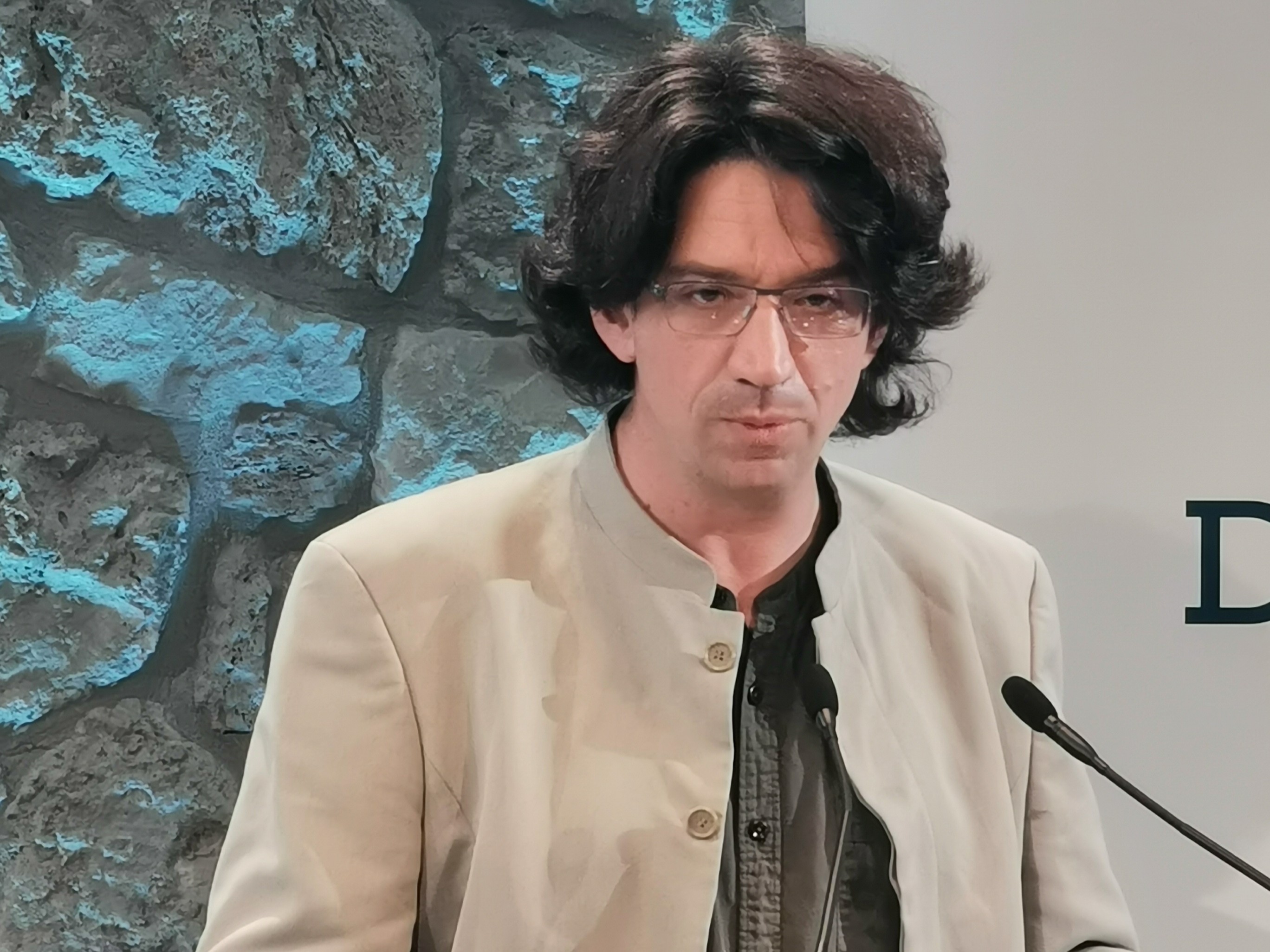
Curtis Yarvin speaking at the Danube Institute’s and The Heritage Foundation's 5th Geopolitical Summit, Danube Institute Budapest, September 15, 2025.
© Elekes Andor / Public domain
As the authoritarian right advances in the United States, developing an accurate understanding of its worldview is a task of some urgency. One way of doing so is by considering the writings of one of its leading intellectuals: Curtis Yarvin.
The software engineer Curtis Yarvin has been blogging since 2007 with an immodest goal: to “build a new ideology.”1 He has met with no little success. His influence extends from politicians like Vice President J.D. Vance and Silicon Valley moguls like Peter Thiel to young conservatives, who ironically refer to him as “Lord Yarvin, Our Prophet.” In his published writings, Yarvin forges a novel articulation of nondemocratic thought with a computational vision of society. As he puts it: “The essence of any 21st-century reaction is the unity of…the modern engineering mentality, and the great historical legacy of antique, classical and Victorian pre-democratic thought.”2 It is in making this linkage that his significance lies.
Yarvin rejects not only liberalism and leftism but also conservatism, which he sees as incapable of resisting the unyielding force of liberalism. As for democracy, he considers it “a dangerous, malignant form of government which tends to degenerate, sometimes slowly and sometimes with shocking, gut-wrenching speed, into tyranny and chaos.”3 Because he does not seek to return political power from elites to the people, Yarvin’s views are best characterized not as populist but as postliberal. He believes ruling elites are desirable; his complaint is that our elites are too democratic. For Yarvin, formal democracy only works to the extent that it is antidemocratic in practice.
Yarvin envisions the state as a corporation divided into shares conferring voting rights. Shareholders would elect boards of directors who would hire managers to handle daily operations. These authoritarian corporation-states would form a loosely connected patchwork, or in Yarvin’s caustic terms: “as the crappy governments we inherited from history are smashed, they should be replaced by a global spiderweb…of sovereign and independent mini-countries, each governed by its own joint-stock corporation.”4 Yarvin identifies Dubai and Singapore as exemplars of this postliberal vision.
Intellectual Influences
Yarvin arrives at these views by combining ideas from several thinkers into a reactionary bricolage. For a time, he embraced the radical free-market thinking of the Austrian school of economics. While he remains sympathetic to Austrian economic thought, he is critical of its anti-statist politics. In his view, this offers no solution to a perennial problem in human affairs: preventing violence. To redress this, Yarvin draws on the work of Thomas Carlyle, who excoriated democracy and advocated authoritarian rule by a heroic leader. Following Carlyle, Yarvin argues that the state must be empowered to take any action necessary to maintain order. Because large organizations are best managed by a single executive, sovereign authority must be held by one individual. Yarvin links this with an understanding of ideology and political conflict derived from the body of thought known as Italian elite theory. He argues that mass opinion creates power, and that ideas are the currency of power because they serve to ground political coalitions. Therefore, a society’s power centers are the sites that produce and disseminate ideas: media, schools, and universities. This troika, which Yarvin refers to as “the Cathedral,” devises theories that favor its interests and funnels its supporters into positions of power. This creates a self-perpetuating feedback loop, as these supporters direct further resources to the Cathedral, reinforcing its position and the liberal democratic culture that is its product. What is to be done about the Cathedral? Yarvin advises reactionaries seeking political change to “liquidate” educational and media institutions but urges magnanimity toward their employees. While they are “bloodsucking parasites,” most will retire quietly if offered a full pension conditional on support for the new regime.
The Computational Metaphor
These extreme views and vituperative rhetoric are not unprecedented. To grasp Yarvin’s significance, we must also consider his computational vision of society. Insofar as it vests authority in impersonal rules, he claims modern government is inherently computational. A constitution, “half a holy document…half a self-updating OS or blockchain contract,”5 combines the civic sacred and the digital profane, while a change of government, or a “hard reset,” is akin to restarting a computer that has crashed. If, as Yarvin claims, American democracy has been “hacked,” meliorism is unlikely to succeed, given the Cathedral’s power to co-opt opposition. A wiser strategy would be “hacking the hack…and booting up a successor state.”6
Yarvin is not the originator of computational thinking. The idea that the world can be conceptualized as an information system undergirds cybernetics, an interdisciplinary field that utilizes the mathematical theory of communication to control and coordinate autonomous machines. In the cybernetic vision, the world consists of interconnected systems linked by patterned forms of organization, surrounded by chaotic “noise.” Systems respond to external environmental stimuli by adjusting their behavior, thereby maintaining themselves over time. While cybernetic ideas emerged out of the US government’s military research during the Second World War, they spread widely through the sciences, contributing to the cognitive revolution in psychology and influencing fields from biology to anthropology to computer science.
Two points of convergence between Yarvin’s thought and the cybernetic model are worth noting. First, in both, biological, social, and technical systems are analogous because all perform the same functions. Since technical and social systems obey the same principles, the same programmers could build them, transforming social and political problems into design problems. Whether this would lead to dystopian control or to utopian rational planning is unclear. Early cyberneticians were aware of the dangers of the former but intrigued by the promise of the latter. Yarvin shares this fascination, although he seems to maintain a privileged role for an elite cadre of social engineers.
Second, Yarvin and the cyberneticians traffic in the same moral language. For one noted cybernetician, order is a self-evident good while disorder is a phenomenon “which…we may consider evil.”7 Yarvin adds an ideological twist: “Evil is chaos, good is order. Evil is left, good is right.”8 Given the anti-humanism of the cybernetic view, this moral language represents a tension in Yarvin’s thought. As always seems to be the case with attempts to objectively ground scientific politics, Yarvin cannot but smuggle normative considerations in through the back door.
Yarvin, Postliberalism, and the Future of Democracy
Curtis Yarvin represents a novel combination of elements in American political thought. He weaves nondemocratic strains of social theory together with a computational understanding of society. While neither is unprecedented, his synthesis is noteworthy. In light of this, we can achieve greater analytic purchase on Yarvin’s thinking, and on the American Right more generally, by treating it not as a type of populism but as a species of an emergent postliberal genus. And this, ultimately, is why Yarvin is significant. He is a bellwether for the direction in which we may be headed. As societies lurch toward despotism and great-power conflict, tech entrepreneurs counsel governments to adopt an “engineering mindset” and hail digitalization as a panacea for fiscal, political, social, and ecological crises. Similarly, as governments model their operations on software “stacks” and computational metaphors for society spread in social theory, Yarvin’s preferred mode of governance seems ascendent. In the meantime, the question of whether American democracy’s antiquated operating system will be replaced with postliberal software remains open.
1 Curtis Yarvin, A Formalist Manifesto, April 24, 2007.
2 Curtis Yarvin, A Gentle Introduction to Unqualified Reservations, ch. 9: The Procedure and the Reaction.
3 Curtis Yarvin, An Open Letter to Open-Minded Progressives, ch. 14: Rules for Reactionaries.
4 Curtis Yarvin, Patchwork: A Political System for the 21st Century, ch. 1: A Positive Vision.
5 Curtis Yarvin, Gray Mirror, #3: Descriptive Constitution of the Modern Regime.
6 Curtis Yarvin, #3.
7 Norbert Wiener, The Human Use of Human Beings, New York 1954, p. 11.
8 Joshua Tait, Mencius Moldbug and Neoreaction, in Mark Sedgwick (ed.), Key Thinkers of the Radical Right; Oxford 2019, p. 192.
James Rosenberg is a PhD candidate at the University of Wisconsin-Madison and WZB Berlin Social Science Center. He was a junior visiting fellow at the IWM in 2025.


