
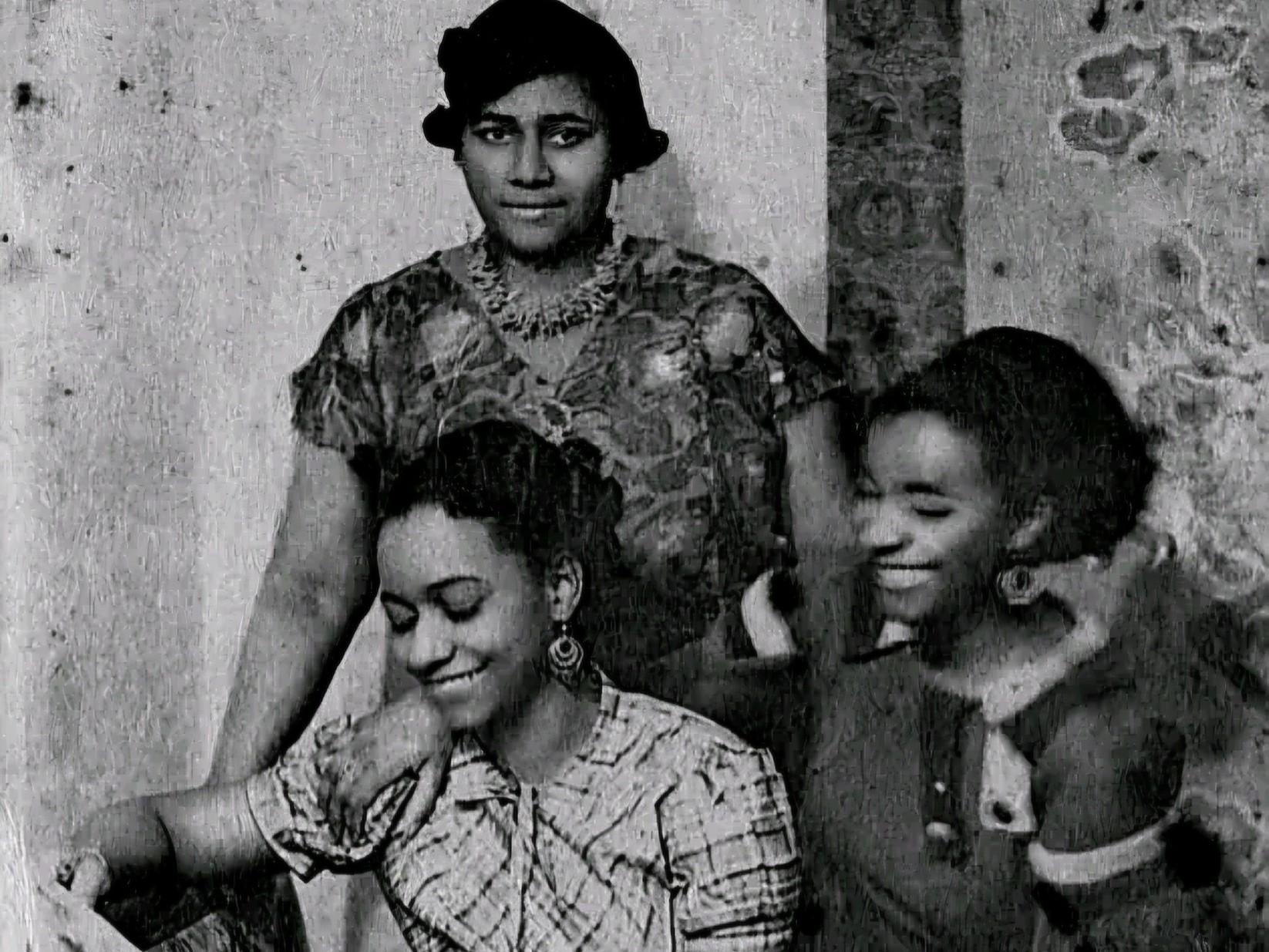
Paulette (standing), Lucie (on the left), and Jeanne Nardal at their apartment in Clamart, outside Paris, October 19, 1935.
© Nardal Collection, Collectivité Territoriale de Martinique, Archives de Martinique
European universities reproduce racialized hierarchies of knowledge. Yet, across the continent, racialized thinkers have been reclaiming intellectual space. From the Négritude movement to the Romnja Feminist Library, their projects have redefined what counts as knowledge and who can produce it.
European universities have long been central to the production and legitimization of racial hierarchies. From the early modern times to the 20th century, prominent and influential European thinkers as well as disciplines such as anthropology, biology, comparative anatomy, and eugenics nurtured ideas of racial difference that justified empire and slavery. These pseudo-sciences cast “Others”—Blacks, Asians, Indigenous and Romani peoples—as intellectually inferior, irrational, or childlike.
Although discredited, these theories still shape knowledge production. Racialized students and staff still experience what the sociologist Philomena Essed calls “everyday racism”: routine practices that materialize structural racism within daily life. Scholars of color accused of pursuing “a passport rather than knowledge,” Muslim students mocked for wearing hijabs, and professors making anti-Roma or anti-Black remarks—such experiences, widespread and cumulative, define who belongs in academia and who does not.
Racism in European universities is also epistemic. The philosopher Kristie Dotson’s concept of epistemic oppression captures the persistent exclusion of marginalized groups from knowledge production. The canons taught in most departments are overwhelmingly dominated by white male Global North authors. The academic claim to universalism conceals a racialized and gendered politics of knowledge that grants universality to some voices and confines others to “identity.” This asymmetry determines who is seen as capable of producing theory and who merely illustrates it. As a result, the knowledge production of racialized and immigrant scholars are pushed to the margins of academic legitimacy.
Transforming this dynamic requires confronting academia’s colonial and racist epistemic foundations and ongoing practices, rather than merely sprinkling “diverse perspectives” into existing frameworks. As institutional change remains slow, much of the most innovative work on racial justice, belonging, and knowledge production now is carried out outside academia.
Counter-Hegemonic Knowledge Projects
Europe has never been racially homogeneous. Its intellectual life has been shaped by migration and complex exchanges, yet the contributions of colonized and racialized populations remain a largely unacknowledged part of the continent’s intellectual legacy. Revisiting past and present counter-hegemonic initiatives helps to challenge this erasure.
The Négritude Movement
After the First World War, a generation of Black intellectuals from French colonies in Africa and the Caribbean gathered in Paris to articulate new understandings of race, belonging, and culture. They rejected Europe’s “civilizing mission” and developed a collective consciousness grounded in pride, solidarity, and cultural affirmation.
In 1928, the Martinican writer Jeanne Nardal published “L’internationalisme noir” in the Parisian magazine La Dépêche Africaine, calling on “Negroes of all origins and nationalities” to recognize their shared identity and struggles. Her vision of a global Black community—l’internationalisme noir—was among the earliest articulations of what would later be called Négritude. Along with her sister Paulette Nardal, Aimé Césaire, and Léopold Sédar Senghor, Jeanne Nardal helped establish a movement that combined literature, political critique, and anticolonial resistance.
The Négritude thinkers exposed the hypocrisy of European universalism in the face of colonial and racist practices. Their writings were foundational to later anticolonial and Pan-African movements, inspiring figures such as Frantz Fanon, Kwame Nkrumah, and Maryse Condé. Although the movement has often been marginalized within European curricula, its influence has reverberated globally: in the struggle against apartheid in South Africa, in racial-equality policies in Brazil and the United Kingdom, and in the anti-racist frameworks that inform contemporary European policy.
The legacy of Négritude illustrates how marginalized intellectuals can reshape global understandings of freedom, justice, solidarity, and humanity. It also reminds us that some of the most consequential emancipatory frameworks emerged from those historically excluded from or marginalized in European academic spaces.
The Romnja Feminist Library
If Négritude was an early instance of transnational solidarity and epistemic resistance, contemporary projects such as the Romnja Feminist Library continue this work in new forms. Founded in 2023 by the Spanish Gitana feminist Alba Hernández Sánchez and the Romanian intersectional activist Aldessa Georgiana Lincan, it is a digital repository and platform dedicated to the intellectual production of Romani women and queer people.
The library’s creation responded to the almost complete erasure of Romani women and queer voices from European public discourse and scholarship. The founders envisioned it as a living archive that documents, preserves, and disseminates Romani narratives and knowledge in multiple disciplines and forms: essays, testimonies, art, community projects, and reflections on daily life. In 2025, it had more than 50 contributors from across Europe.
By curating these works, the Romnja Feminist Library does more than fill an archival gap. In a context where the Roma are often portrayed as illiterate or “traditionally minded,” it reclaims their intellectual agency and redefines Romani women and queer people as thinkers and theorists. In doing so, the project unsettles long-standing academic epistemic hierarchies that dictate what counts as knowledge and who is entitled to produce it.
Fundamentally, the library’s multilingual and multiformat materials illuminate systemic oppression and acts of resistance. They both trace enduring practices of state violence (such as forced sterilization, child removal, and criminalization) and assert Romani citizenship and rights through monitoring state compliance with international commitments.
But perhaps the library’s most radical gesture lies in its refusal of the white gaze. By representing Romani women and queer people on their own terms, it replaces stereotyped portrayals with self-definition, transforming beyond the archiving the very conditions of knowledge production in Europe. It is not only a repository but also a site of epistemic resistance, a space where marginalized communities reclaim the authority to define the content, the meaning, and the purpose of knowledge production in Europe.
Rethinking Europe Through Epistemic Resistance
The Négritude movement and the Romnja Feminist Library exemplify the long history of epistemic resistance by racialized people in Europe. Far from being “anti-European” or “niche,” such initiatives are integral to the continent’s memory and intellectual heritage. They reveal the contradictions at the heart of Europe’s self-image as a cradle of humanism and democracy, exposing how the silencing of oppressed voices has underpinned that image.
By centering the voices of those historically silenced, such initiatives contribute to expanding Europe’s democratic repertoire. Their significance lies not only in revealing colonialism, racism, and patriarchy as pillars of European societies but also in the alternative visions they offer. These projects advance broader frameworks on democracy, solidarity, plurality, and justice.
For European academia, these histories and practices pose a critical challenge. Universities must decide whether to remain complicit in reproducing racialized hierarchies or to confront their colonial epistemic ideas and practices and to open themselves to transformation. Democratization of knowledge production cannot be achieved through diversity statements and other superficial policies. It requires a deep reckoning with how knowledge itself has been produced, authorized, and mobilized.
At a time when patriarchal and racist forces once again threaten democratic values, this reckoning is urgent. The fundamental question is not whether Europe can “integrate” racialized and immigrant knowledge producers into its institutions, but whether it can recognize them as co-authors of its intellectual and political future.
Bruna Cristina Jaquetto Pereira is postdoctoral researcher at Complutense University of Madrid. She was an Emma Goldman fellow at the IWM in 2025.


