
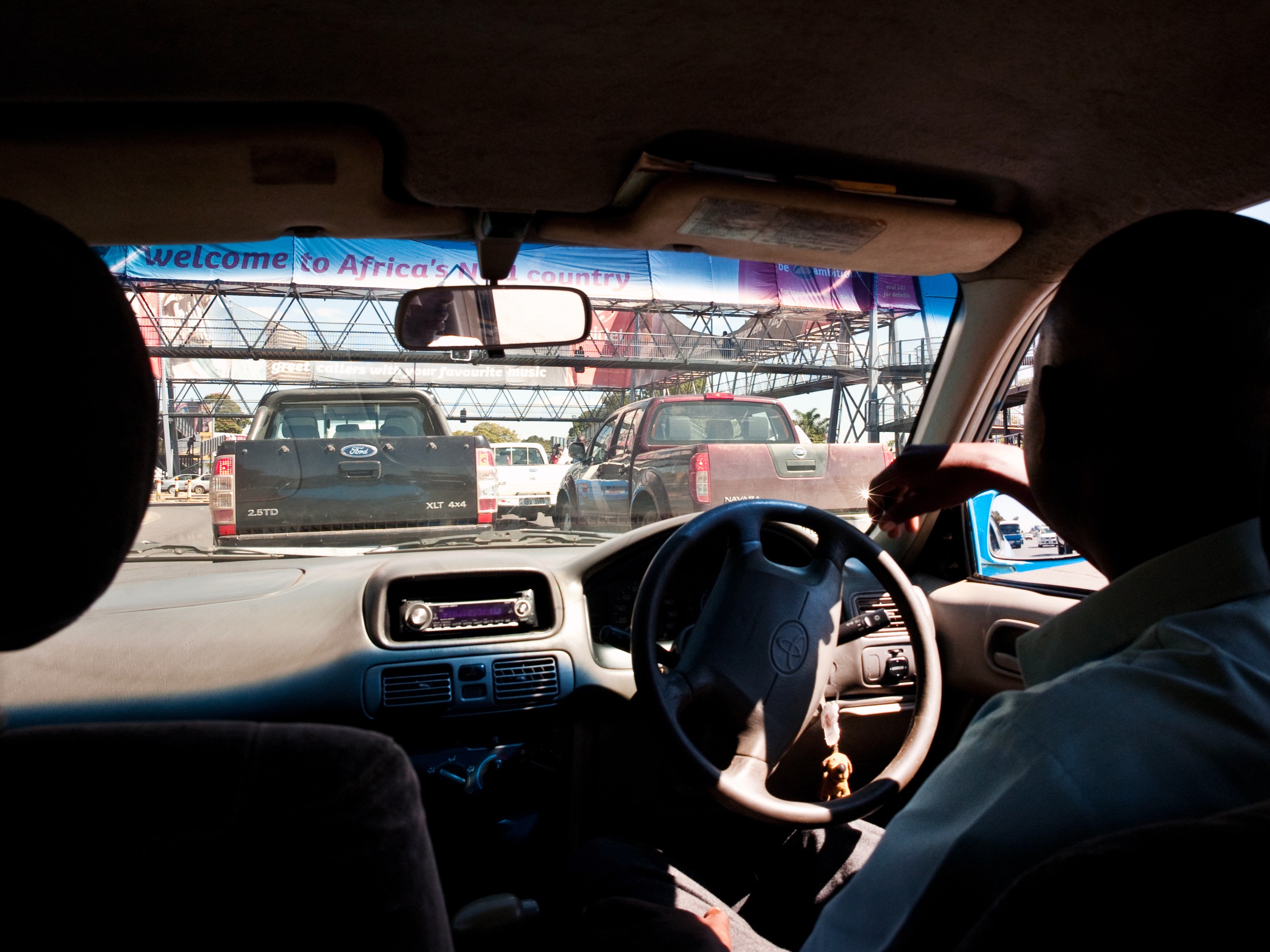
Inside the taxi cab in Lusaka, Zambia
© FOTOGRAFIA INC. / istockphoto.com
Promising freedom and flexibility, the gig economy in developing countries might instead consolidate economic fragility and solitude. It sells immediate work and it delivers dependencies. Are there tools for turning digital platforms into channels for genuine inclusive growth?
Emmanuel picks me up after a few minutes of waiting outside Melisa Supermarket in Lusaka. “Thank you, sir, for waiting and not cancelling the ride, there’s a lot of traffic at this hour. You are only my fifth customer of the day.” His experience reflects that of thousands of drivers in the Zambian capital, navigating the same precarious earnings. They all work for the same company: Yango, the local market name for Yandex, the Russian giant in urban mobility. “I lost my job a few months ago, when the company I worked for closed down,” he says. “I just needed a way to make some kwacha [Zambia’s currency] and signing up for Yango was the quickest option.”
The gig economy has exploded in sub-Saharan Africa, a work model that finds fertile ground in the difficulty of finding a stable source of income. Emmanuel is a “survival entrepreneur”: an entrepreneurial status in name only, driven by necessity, not vocation. He pays a weekly rental fee of 2,000 kwacha to the vehicle’s owner. “Every Sunday is a relief just for making it,” he admits. That is a significant figure for a driver’s balance sheet when rides start at 22 kwacha (€0.80) and rarely exceed 80 kwacha. From the fare, taxes, the platform’s commissions (about 20 percent), and fuel and airtime costs must then be subtracted. All costs that force drivers to always remain at the algorithm’s disposal, hustling for rides continuously just to break even.
The Information Asymmetry and the Technological Capital
The Yango business model is based on a network of partners, acting as recruitment and registration hubs for local drivers, and fleet owners who provide long-term car leases. To receive orders, drivers must pre-pay commissions and taxes for each ride on the app, a mechanism to protect against the risk of driver insolvency. The platform determines ride fares via a dynamic pricing system and directs orders to drivers who are available and in good standing with their commission payments. Though drivers are classified as self-employed workers or contractors, in practice they are subjected to the app’s decisions and have no negotiating power.
The freedom of flexible work comes with the downside of workers’ uncertain status, and many drivers complain about the platform’s lack of transparency. Once a ride is accepted, for instance, drivers know neither the customer’s exact location nor the destination, and consequently the fare applied to the route. Refusing a ride once accepted, under the algorithmic control management system on which the platform is built, leads to various forms of penalization for the driver: from lower visibility in the algorithm and negative reviews that lower their average score (which are visible to the user) up to temporary suspensions from activity.
This information asymmetry is biased against drivers, who often feel forced to accept unprofitable rides, solely to safeguard their reputation on the platform. In this form of modern capitalism, Karl Marx’s ideas of property in “land” and “machinery” are replaced by property in “platform” as platforms simultaneously are access points to work and to means of production.” Behind the illusion of micro-entrepreneurship, the value-production system is configured so that the ownership of technological capital, in the hands of the platform, extracts value from the supposed freedom and flexibility of labor.
Through distant algorithmic management, the platform exerts control over the necessary work infrastructures, reshaping the social and economic relations across an entire sector. This extractive model is enabled by the local near-monopolistic dominance of the necessary technology and the substantial initial capital required to become a major player. The entry barriers are too high for local entrepreneurial initiatives.
Without competition and regulatory oversight, the platform prospers by maximizing its own interests while cloaking itself in the apparent positive contribution it makes to local employment.
The Tripartite Acquiescence
Where there are few alternatives, the app presents itself as a relatively quick and accessible route out of unemployment. In a country like Zambia, where approximately 80 percent of the economy is informal and job precarity is a daily challenge, it is understandable that many workers view this opportunity positively.
On the customer side, users benefit from the efficiency promised by a scalable and algorithmically optimized platform: lower fares, shorter wait times, and a superficial yet reassuring sense of safety thanks to the visible in-app driver ratings. It configures a system that projects order and control even in the absence of genuine systemic guarantees.
Finally, the state seems to have few incentives to intervene in a regulatory sense. Hindering a private actor that tackles structural issues such as employment and urban mobility could force the public sector to confront these problems directly. Until now, the digital market has shouldered these social costs rather than public funds.
This tripartite system reveals a social acquiescence that supports the platform economy: a system that fuels external dependencies and uncertainty, shrinks local autonomy, and consolidates forms of economic asymmetry behind the facade of technological progress and growth opportunities.
Not everything is to be rejected, nor should the gaze remain only critical. The platform, with all its limits, provides a real opportunity for many, with personal benefits too. “Now I get home every evening to my wife and children,” says Loveday, a former long-haul trucker. “There is surely more uncertainty in earnings, but if you know how to hit peak hours and work when fares are higher, you can live decently. You have to be clever, exploit the app to your advantage.”
In short, a flawed job is better than no job and an informal network is better than an occupational void. And yet, it is precisely the structural informality of this model, even when it works, that limits its transformative potential.
Integrating Platform Workers Into Social Security
In the absence of formal contracts, pay slips, social security contributions, or protection mechanisms, long-term benefits out of reach for workers, with no access to loans or formal credit, no safety net for injury or illness, and the difficulty of creating strong union structures to support collective bargaining. The freedom the platform promises comes with systemic solitude, which leads to long- term uncertainty: workers survive day by day, unable to plan far ahead, hoping the algorithm turns in their favor.
The point is not to deny the digital potential in developing settings, but rather to discern the conditions under it can be a truly inclusive force for structural growth. One path is to integrate digital platforms into national protection systems, extending social-security programs to gig workers and incentivizing hybrid forms of mutual contribution. As the World Bank notes, there is a “missed middle” in social protection, composed of those who are not poor enough for safety nets but lack the protections typical of the formal economy. It is in this grey zone that a large part of the gig economy workforce is. A promising benchmark is Rwanda’s Ejo Heza [Brighter Future] Long- Term Saving Scheme: a voluntary defined-contribution scheme that uses targeted incentives fitting the characteristics of informal-sector workers. Driven by its accessibility (via dialer codes and mobile money), a flexible contribution design aided by public co-contributions, and the inclusion of short-term benefits (such as, funeral insurance), the scheme has achieved remarkable adoption rate. In six years, it has registered about 3.5 million people (around 42 percent of the working-age population), over 90 per cent of them from the informal sector.
The effects on savings, financial literacy, and individual risk mitigation are already evident. In the long term, the state will potentially benefit from an economically less vulnerable population and improved visibility into informal employment, lowering public expenditure on purely distributive assistance programs.
It is not unrealistic to imagine similar schemes being embedded directly into digital work apps, with contributions deposited by online workers through these. In a digital economy moving faster than policies and social protections, the lack of a strategic vision for integrating innovation and rights means that even the most promising opportunities risk reproducing old inequalities in new forms.
Ivan Napoli is a PhD student in the economics of innovation at UCSC of Milan. In 2025, he was a junior visiting fellow in the Digital Humanism Program at the IWM.


